1.What do you understand by ‘people as a resource’?
Answer : People as a resource is a way of referring to the country’s working population interms of their existing and potential productive skills and abilities.
Question2. How is human resource different from other resources like land and physicalcapital?
Answer: Human resource makes use of other resources like land and physical capital toproduce an output. The other resources cannot become useful on their own. This is thereason why human resource is considered to be superior to the other resources.
Question3. What is the role of education in human capital formation?
Answer : Education is the most important component of human resource development.
→Proper education and training enable the formation of this human capital. An educatedpopulation is an asset, a resource.
→ Education enhances the quantity and quality of individual productivity, which in turnadds to the growth of the economy.
→It develops personality and sense of national consciousness among the people which areimportant for rapid economc growth.
Question4.What is the role of health in human capital formation?
Answer: Health plays an important role in human capital formation. A healthy person ismore likely to realize his full potential and can become an asset for the economy through hisproductivity. An unhealthy person is less likely to realize his potential and can become a liability for country
Russian Revolution PPT
7th Constitution
6th plateau
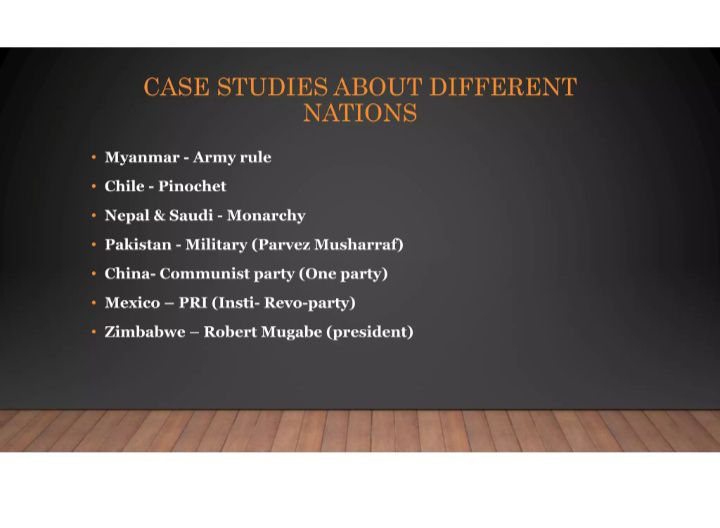
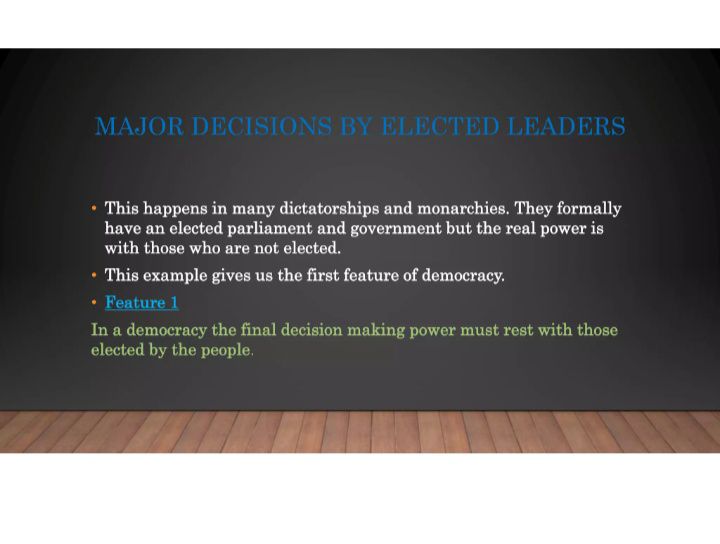
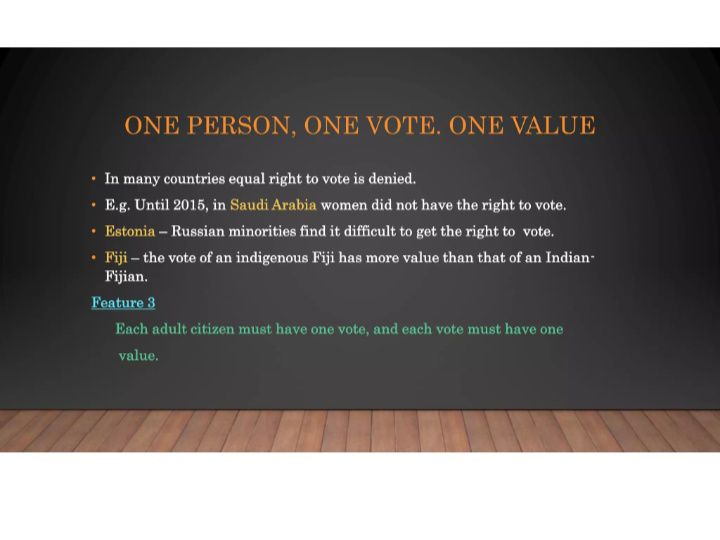
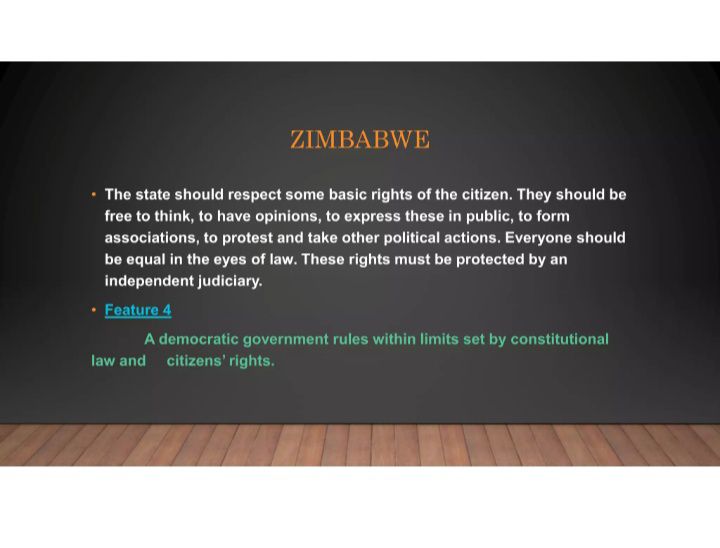
Democracy








Palampur
- Modern farming methods require more inputs which are manufactured in industries. Do you agree?
Answer:Yes, it is correct to say that modern farming methods require more inputs which are manufactured in industries. It is because modern farming methods use high-yielding varieties of seeds. These seeds require both chemical fertilisers and pesticides, agricultural implementations like tractors and proper irrigation facilities like electric tube wells, and all these elements are manufactured in industries. - How did the spread of electricity help farmers in Palampur?
Answer:The spread of electricity helped the farmers of Palampur as it aided in the transformation of the irrigation system of the village. The farmers earlier used Persian wheels to draw water from wells and irrigate small fields. But after the spread of electricity, electric tube wells replaced these Persian wheels. - Is it important to increase the area under irrigation? Why?
Answer:It is important to increase the land under irrigation because farming is the main source of income for the maximum part of the population in India. Farmers are dependent on the erratic monsoon season, and if the rainfall is less, farmers are bound to suffer a major loss. So if the water is provided for irrigation to the farmers for a larger portion of land, it would give better output and make more land cultivable in India - Construct a table on the distribution of land among the 450 families of Palampur.
Answer:The distribution of land among the 450 families of Palampur is as given below:
Area of land Cultivated Number of Families
0 150
Less than 2 hectares 240
More than 2 hectares 60 - Why are the wages for farm labourers in Palampur less than minimum wages?
Answer:There are many landless farm labourers who are paid less than the minimum wages in Palampur. The Government-declared wage for a farm labourer is Rs 300 per day, but the competition for work among the farm labourers is very high, which is why people agree to work for lower wages. - What are the different ways of increasing production on the same piece of land? Use examples to explain.
Answer:To grow more than one crop on a piece of land during the year is known as multiple cropping. The best example of this is the cultivation in Palampur. In Palampur, jowar and bajra grow during the rainy season, followed by potato between October and December, and during the winter season, wheat is sown in the fields. - Describe the work of a farmer with 1 hectare of land.
Answer:A farmer with 1 hectare of land will be called a small farmer. Since the area for cultivation is small, the outcome may also not be high. So, in order to be able to get the best possible yield, the farmer needs money. This money is borrowed from a moneylender at a high interest rate and at times may also have to work as a farm labourer for the moneylender. Once the farm is cultivated, the produce has to be divided for personal use and for selling in the market. Whatever profit is earned, the farmer has to usually give it away to the moneylender, and little money is left for the use of the farmer himself. The only help a small farmer gets is that of his family members. - How do the medium and large farmers obtain capital for farming? How is it different from the small farmers?
Answer:Large and medium farmers sell surplus farm products from a part of their produce. A part of the earnings is saved and kept for buying capital for the next season. A few of them give away the savings to small farmers and loans at high interest rates and get back the amount by the next season. Thus, they are able to arrange for the capital for farming from their own savings. Some farmers might also use the savings to buy cattle, trucks, or to set up shops. - On what terms did Savita get a loan from Tejpal Singh? Would Savita’s condition be different if she could get a loan from the bank at a low rate of interest?
Answer:Savita got a loan from Tejpal Singh at the rate of interest of 24 per cent for four months and also had to work for Tejpal Singh as a farm labourer at the wage of Rs 100 per day during the harvest season. The case would have been different if Savita had taken the loan from a bank. The rate of interest would have been lesser than what was asked by Tejpal Singh and also she would have been able to pay complete attention to her own field during the time of harvest.
- What are the non-farm production activities taking place in your region? Make a short list.
Answer:The non-farm production activities taking place in our region are as follow:
Dairy
Transportation
General Stores
Fishing
Mining - What can be done so that more non-farm production activities can be started in villages?
Answer:To promote more non-farm production activities in villages, the following steps can be taken:
Loans must be available for people at lower interest rates so that they can start the non-farm production activities.
Proper markets should be set up so that the produced goods can be sold.
The concerned authorities must set up better transportation between cities and villages so that the produced goods can be transported to cities and more money can be earned through the non-farming activities.
India size and location
NCERT Solutions for Class 9 Geography Chapter 1
Q.1. Choose the right answer from the four alternatives given below.
(i) The Tropic of Cancer does not pass through (a) Rajasthan (b) Odisha (c) Chhattisgarh (d) Tripura
(ii) The easternmost longitude of India is (a) 97° 25′ E (b) 68° 7′ E (c) 77° 6′ E (d) 82° 32′ E
(iii) Uttarakhand, Uttar Pradesh, Bihar, West Bengal and Sikkim have common frontiers with (a) China (b) Bhutan (c) Nepal (d) Myanmar (iv)
(lv)If you intend to visit Kavarati during your summer vacations, which one of the following Union Territories of India will you be going to (a) Puducherry (b) Lakshadweep (c) Andaman and Nicobar (d) Daman and Diu (v)
(v)My friend hails from a country which does not share a land boundary with India. Identify the country. (a) Bhutan (b) Tajikistan (c) Bangladesh (d) Nepal
Answer:
(i) The Tropic of Cancer does not pass through – (b) Odisha .
(ii) The easternmost longitude of India is – (a) 97° 25′ E .
(iii) Uttarakhand, Uttar Pradesh, Bihar, West Bengal and Sikkim have common frontiers with (c) Nepal .
(iv) Kavarati is situated in the union territory of (b) Lakshadweep .
(v) (b) Tajikistan does not share a land boundary with India.
Get access to Board PYQs in PW Books App
Q. 2. Answer the following questions briefly.
(i) Name the group of islands lying in the Arabian Sea. (ii) Name the countries which are larger than India. (iii) Which island group of India lies to its south-east? (iv) Which island countries are our southern neighbours?
Answer
(i) India is situated in the Northern Hemisphere, with its mainland spanning between latitudes 8°4’N and 37°6’N, and longitudes 68°7’E and 97°25’E. The Tropic of Cancer (23° 30’N) divides the country into nearly equal halves. To the southwest of the mainland lie the Lakshadweep islands in the Arabian Sea, while to the southeast lie the Andaman and Nicobar islands in the Bay of Bengal.
(ii) Several countries surpass India in size, including Russia, Canada, the USA, China, Brazil, and Australia. Among them, Russia is the largest with an area of 17.09 million sq.km, whereas India covers an area of 3.28 million sq.km.
(iii) The Andaman and Nicobar islands are positioned to the southeast of India in the Bay of Bengal. India shares land borders stretching approximately 15,200 km. Additionally, its coastline, encompassing the Andaman and Nicobar Islands and Lakshadweep, extends over 7,516.6 km.
(iv) Sri Lanka and the Maldives are island nations located to the south of India. The Maldives lies to the south of the Lakshadweep Islands, while Sri Lanka is separated from India by a narrow channel comprising the Palk Strait and the Gulf of Mannar.
Q.3. The sun rises two hours earlier in Arunachal Pradesh as compared to Gujarat in the west, but the watches show the same time. How does this happen?
Answer:
India spans approximately 30 degrees both latitudinally and longitudinally, with its north-south extent being greater than its east-west extent. Consequently, there’s a two-hour time difference between Gujarat and Arunachal Pradesh. Due to its eastern location, Arunachal Pradesh witnesses sunrise earlier than Gujarat. The Standard Meridian of India, passing through Mirzapur (in Uttar Pradesh) at 82°30’E longitude, establishes the country’s standard time. This means that despite the varying solar times across India, the clocks display the same time nationwide. The latitudinal extent impacts the duration of daylight, with longer days observed as one moves from south to north. As a result, regardless of geographical location, watches indicate uniform time throughout the country.
Q. 4. The central location of India at the head of the Indian Ocean is considered of great significance. Why?
Answer:
India extends southward from the Asian continent, occupying a central position between East and West Asia. Positioned strategically, the Indian Ocean surrounds India, serving as a crucial link between East Asian nations and Europe in the west. The protrusion of the Deccan Peninsula into the Indian Ocean further enhances India’s connectivity. This geographical feature facilitates close interactions with West Asia, Africa, and Europe from the western coast, while also establishing connections with Southeast and East Asia from the eastern coast. India’s unique geographical positioning, with a vast coastline along the Indian Ocean, justifies the naming of the ocean after it. This distinctive characteristic sets India apart, as no other country boasts such an extensive coastline along the Indian Ocean.
Q.5. Identify the following with the help of map reading.
i. The Island groups of India lying in the Arabian Sea and the Bay of Bengal.
Answer:
Lakshadweep and Andaman & Nicobar Islands ii. The countries constituting Indian Subcontinent. Ans: Countries in the Indian Subcontinent are India, Nepal, Bhutan, Bangladesh, Sri Lanka, Maldives and Pakistan. iii. The states through which the Tropic of Cancer passes. Ans: The Tropic of Cancer passes through Gujarat, Rajasthan, Madhya Pradesh, Chhattisgarh, Jharkhand, West Bengal, Tripura and Mizoram. iv. The northernmost latitude in degrees. Ans: 37°6′ N v. The southernmost latitude of the Indian mainland in degrees. Ans: 8°4′ N vi. The eastern and the western most longitude in degrees. Ans: Western longitude is 68°7′ E and the Eastern longitude is 97°25′ E vii. The place situated on the three seas. Ans: Kanyakumari viii. The strait separating Sri Lanka from India. Ans: Palk Strait ix. The Union Territories of India. Ans: Andaman and Nicobar Islands, Chandigarh, Dadra & Nagar Haveli and Daman & Diu, Delhi, Lakshadweep, Puducherry, Ladakh, Jammu and Kashmir.
9th civics chapter-2
French Revolution solutions
1.Describe the circumstances leading to the outbreak of revolutionary protest in France.
Answer:When King Louis XVI was anointed as the new king, he found an empty treasury. Long years of war had drained the financial resources of France. On top of this, there was the cost of maintaining an extravagant court at the Palace of Versailles.
France had helped the thirteen American colonies gain their independence . The war added more than a billion lives to a debt that had already risen to more than 2 billion livres. Lenders who gave credit began to charge 10 percent interest on loans. So the French Government had to spend an increasing percentage of its budget on interest payments alone.
To meet its regular expenses, Raising taxes did not suffice, because French society was divided into 3 estates and only the 3rd estate had to pay taxes. The 1st estate and the 2nd estate did not pay any taxes. The population of France was also growing massively.
This led to a rapid increase in the demand for food grains. Production of grains could not keep pace with demand. So the price of bread, which was the staple diet of the majority rose rapidly. Most workers were employed as laborers in workshops, whose owner fixed their wages. But the wages did not keep pace with the rise in prices. So the gap between the rich and the poor widened. All these factors led to the outbreak of the French Revolution.
2. Which groups of French society benefited from the revolution? Which groups were forced to relinquish power? Which sections of society would have been disappointed with the outcome of the revolution?
Answer:French society was divided into 3 estates. The third estate benefitted the most. The third estate consisted of Peasants, artisans, small peasants, landless labor, servants, big businessmen, merchants, court officials, lawyers, etc.
The groups that were forced to relinquish power were the people belonging to the 1st and 2nd estates. These people had enjoyed certain privileges by birth. With the revolution, the people in the 1st and 2nd estates lost their privileges. Because inequality was one of the root causes of the revolution, the revolution tried to bring equality to society.
3. Describe the legacy of the French Revolution for the peoples of the world during the nineteenth and twentieth centuries.
Answer:The ideas of liberty and democratic rights are the most important legacies of the French Revolution. These spread from France to the rest of Europe during the nineteenth century, where feudal systems were abolished.
Colonized people reworked the idea of freedom from bondage into their movements to create a sovereign nation-state. Tipu Sultan and Ram Mohan Roy are two examples of individuals who responded to the ideas originating from Revolutionary France.
4. Draw up a list of democratic rights we enjoy today whose origins could be traced to the French Revolution.
Answer:The list of democratic rights are
Freedom of speech
Freedom of expression
Freedom of press
Abolition of censorship
Right to vote
Abolition of slavery
Right to liberty
Right to property
Right to security
Right to education
Divorce laws
5. Would you agree with the view that the message of universal rights was beset with contradictions? Explain.
Answer:Though it says ‘Universal Rights’, women were unfortunately left out of the basic rights that were promised. They did not have equal rights that men enjoyed. They did not have the right to liberty, property, security, and above all, resistance to oppression.
In the formulation of laws, women did not have any representation. Women were not entitled to all the honors and public employment, according to their abilities.
6. How would you explain the rise of Napoleon?
Answer:Napoleon Bonaparte crowned himself Emperor of France. He started conquering neighboring countries by waging wars against them. He saw himself as a modernizer of Europe.
He introduced many laws, such as the protection of private property and a uniform system of weights and measures provided by the decimal system. Many of his measures carried the revolutionary ideas of liberty and modern laws to the other parts of Europe. This had a positive impact on people long after he was dethroned as an emperor when he was finally defeated in the Battle of Waterloo.
 Site Title